top of page
GeoLogin 3G: Geochemistry, Geology & Geophysics
Methodology for low-T thermochronology
a) Number of samples
This is difficult to say how many samples are needed for a given basin but I can give you examples.
-
Sub-Andean Zone of Ecuador and Amazon Basin: 90 samples (substratum + overlying Cretaceous to Pliocene pile)
-
Eastern Andes and Madre de Dios Basin Peru: 60 samples (basement, Paleozoic to Pliocene cover)
-
Western High and Anti-Atlas, including basins and Sahara: 80
-
Zagros - Iran: 70
-
Caucasus + Kura-Rioni basins (2 section against the chain, in Georgia and Russia): 30
-
Tunisia: 10
-
Andes (Peru): 30 samples (bedrocks and cuttings, CNPC), 40 samples (bedrocks and cuttings, PlusPetrol
b) Mineral separation for low-temperature thermochronology
-
Selection of key lithologies from key-regions under my supervision (the amount of samples depends on the objectives)
-
Accurate lithologies are all magmatic rocks (volcanics, plutons, breccias), metamorphics ones, continental sediments (silt, slumps, conglomerates & sandstones).
-
A non-polished 20 microns thin section is made
-
Sample is being separated (see animation below)
-
Heavy liquids separation (density of 3.1 and 3.3). Apatite mineral has a density of 3.10-3.15 whereas zircon reaches 4.8
-
Iron rich aggregates or minerals are removed with a magnet
-
Apatite and zircon rich fractions will be selected by hand-picking

Mineral sep.1

Min. sep. 2
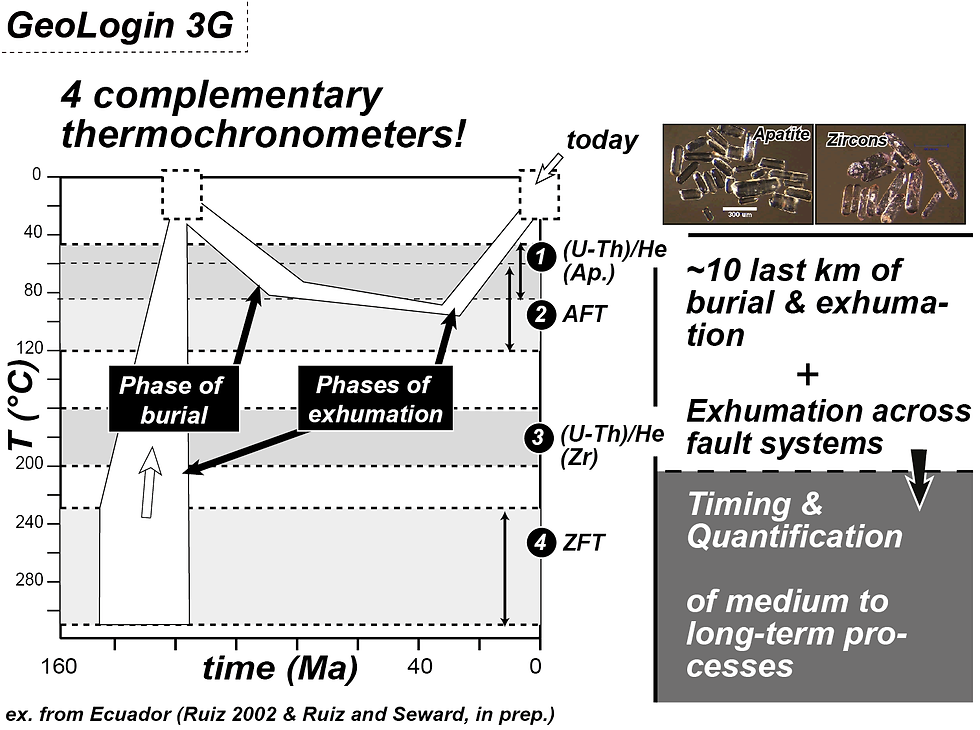
Exhumation & burial
Mineral sep.1
1/7
c) Fission-Track analysis
-
Apatites are mounted into epoxy, polished and chemically attacked with acid to reveal the tracks due to the spontaneous decay of U238. U235 (more stable) is later investigated through an ICP-MS. Length and width of the U238 tracks are measured because they represent the chemical composition of the apatite to allow thermal modelling with the help of external input parameters.
-
For Zircons the principle is the same and the acid utilized is much more dangerous (NaOH-KOH). For Fission-Track on apatite and zircon up to 40 crystals should de dated to get an age but more is better like for sediments
d) U-Th-Sm/He analysis
From the Apatite and zircons separates, the inclusion free crystals are selected and packed for determining the He content thanks to a quadrupole mass spectrometer whereas U, Th and Sm are determined using an ICP-MS. Up to 5-3 crystals should be analysed to produce a reliable age.
e) After collecting the data
They are first all put back into their geological context (map, section), age-altitude profiles, constraining denudation and sedimentation rates. Once all information are collected I proceed to the reverse modelling of all thermochronological data to generate the paleo-thermal history of basin fill series.
f) Reports, interpretation and conclusions
Turn around from sampling to report is roughly 6 months but can be reduced to 4 months. I will produce a detailed report with all data where I will interpret them with some input on your side because you know better than me the basin you have chosen.
bottom of page